Archive for the ‘Finance’ Category
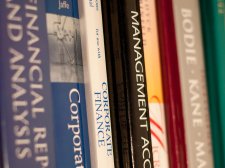 Link: http://www.npr.org/blogs/money/2014/10/03/353300404/episode-573-why-textbook-prices-keep-climbing
Summary: Something strange is going on in the textbook market. The price has steeply increased over the past decade–and they’re only getting higher. There is a disconnect between the chooser (the professors) and the buyers (the students). Technically, the professor is the consumer, and they’re spending their students’ money. The podcast offers the opposite: high school textbooks, where costs are kept low because the books are paid for by the schools.
Original Air Date: October 3, 2014
Length: 14 minutes 56 seconds
Discussion Question/ Prompt: Propose a solution to the rising textbook price problem. (Example: a price ceiling? professor awareness of prices? incentives for lower prices?)

Link: http://www.marketplace.org/topics/business/why-ibm-paying-15-billion-lose-business
Summary: IBM has fell 7 percent off its stock price this week. IBM is selling its chip making company to GlobalFoundries for $1.5 billion over the next three years. It would sound unconventional, except when looking to the future. IBM will be receiving chips for the next ten years from GlobalFoundries. Deals like this are exceedingly rare, but IBM has realized truth: it would be more costly to shut down than to sell, and they may be saving money in the end.
Original Air Date: October 20, 2014
Length: 2 minutes 22 seconds
Prompt / Discussion: Discuss how this type of deal differs from collusion.
 Link: http://freakonomics.com/2014/10/02/fixing-the-world-bang-for-the-buck-edition-a-new-freakonomics-radio-podcast/
Summary: Return on Investment (ROI) analyzes at the most efficient way to spend money. An example given is the difference between curing malaria and HIV/AIDS. To cure malaria, it would cost about $1,000 per person, while it would cost ten times that to cure HIV/AIDS, and it is decided that they would rather save 10 people from malaria before they save one from HIV/AIDS. The United Nations, with their Millennium Development Goals coming to a close, will be looking to set new goals in 2015, to be completed by 2030. One of the issued they will focus on is how they are setting goals, and how to be more efficient with the help of the Return on Investment analysis.
Original Air Date: October 2, 2014
Length: 43 minutes 34 seconds
Prompt / Discussion: You are a member of the United Nations, and are put in charge of coming up with new development goals for 2015. You have $100 billion to invest in various development aid. Discuss how you would prioritize between an important, expensive goal (such as getting all kids into school, which was one of the Millennium Development Goals), and something that might not be seen as highly important, but cost effective.
 Link: http://www.marketplace.org/topics/your-money/my-biggest-financial-lesson/kenneth-feinberg-placing-value-life
Summary: Kenneth Feinberg discusses the reality of compensating families of victims of horrific tragedies. He advises we all plan for tomorrow.
Original Air Date: March 27, 2015
Length: 3 minutes 35 seconds
 Link: http://www.marketplace.org/topics/your-money/my-biggest-financial-lesson/david-brancaccio-wants-you-consult-your-future-self
Summary: In this podcast, Brancaccio describes a term called “hyperbolic discounting” in which people look for instant gratification that in turn clouds their financial decisions.
Original Air Date: March 25, 2015
Length: 3 minutes and 58 seconds
 Link: http://www.npr.org/blogs/money/2015/03/25/395099177/episode-443-dont-believe-the-hype
Summary: The Planet Money team investigates the Dow Jones industrial average and its relevancy to both the stock market and the real economy, exposing its major flaws.
Original Air Date: March 25, 2015
Length: 18 minutes 15 seconds

Link: http://www.npr.org/blogs/money/2015/01/21/378851598/episode-597-were-short-america
Summary: The Planet Money team investigates the less popular side of the Stock Market called shorting. In this podcast the team examines the high-risk high-reward nature of shorting stocks while making an interesting bet of their own against America.
Original Air Date: January 22, 2015
Length: 20 minutes
 Link: http://www.marketplace.org/topics/economy/special-shopping-day-overload
Summary: The number of shoppers on Black Friday was down this year (2014). Because of the ease in comparing prices online to find the best deal, Black Friday (and the whole weekend) has become a ritual team effort of mothers, daughters, and other relatives.
Original Air Date: December 1, 2014
Length: 1 minute 47 seconds
Discussion Question: Is the economy effecting how many people shop on the Black Friday weekend? Or is it something else that’s driving the number of shoppers down?
 Link: http://www.npr.org/blogs/money/2014/11/07/362060876/episode-581-free-money
Summary: This podcast discusses arbitrage (free money), using the example of used textbooks. Arbitrage (free money) is a risk-free way to buy low and sell high. You can find one thing that’s selling for two different prices, and exploit the mistake.
Original Air Date: November 7, 2014
Length: 14 minutes 29 seconds
Prompt: Imagine you find an opportunity like the one discussed in the podcast. Write an outline of how you would go about this discovery, and what your plan of action would be.
Discussion Question: A woman in the podcast said their practice was immoral. Do you agree or disagree? Is what these two men are doing wrong? Use economic thinking in your discussion.
 Link: http://www.marketplace.org/topics/economy/interstate-tax-break-battle
Summary: The Obama Administration has been cracking down on inversions–where companies avoid US taxes by getting a foreign address. Now, it is being taken down to a state level, as states hand out tax breaks to try to increase business and get out of the Great Recession.
Original Air Date: September 24, 2014
Length: 2 minutes 27 seconds
 audioecon