Link: http://www.npr.org/blogs/money/2011/03/09/134370052/the-tuesday-podcast-money-buys-happiness
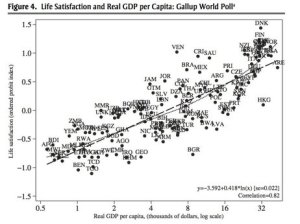
Summary: Discussion of the economics of happiness with economist Justin Wolfers.
Original air date: March 8, 2011
Length: 22:41
Main story content begins: 3:35
Link: http://www.npr.org/blogs/money/2010/10/01/130267274/the-friday-podcast-how-four-drinking-buddies-saved-brazil

Summary: Presentation of the origins of the introduction of the Brazilian Real in 1994.
Original air date: October 1, 2010
Length: 29:56
Main story content begins: 3: 27
Link: http://www.npr.org/blogs/money/2011/06/13/137109349/the-friday-podcast-the-case-for-preschool

Summary: Discussion with economist James Heckman on the findings of a study of the economic and social impacts of preschool.
Original air date: June 10, 2011
Length: 21:14
Main story content begins: 3:12
Discussion Prompt: If you were the U.S. Secretary of Education considering whether to require universal preschoool for all children in the U.S., what factors from the podcast might you consider as you weighed the costs and benefits of this decision? What other factors (not included in the podcast) might you need to consider (or might, say, the President of the U.S. or Congress need to consider). Which of these factors do YOU think would be most important to consider, and why?
Follow-up Prompt: If you were promoted (!) to President, what sort of tradeoffs might you have to think about that are different from those of the Education Secretary? What might you have to take into account from that higher perspective? How can you see – from either position – that budgets reflect scarcity, choices and tradeoffs?
Link: http://www.npr.org/blogs/money/2010/08/20/129328075/the-tuesday-podcast-allowance-economics

Summary: Interview with Economist Joshua Gans, author of Parentonomics, on the use of incentives for children and the lessons for economic policy
Original air date: August 20, 2010
Length: 18:09
Main story content begins: 2:42
Discussion Prompt: Why do you think it was difficult at first to determine the right reward to give to provide an incentive for the kids to use the potty? How do you think this discussion of incentives helps us understand the economic idea that “incentives and economic systems impact choice in predictable ways”?
Follow-up Prompt: The podcast also talked about the idea of ‘budget constraint’ through Bea’s allowance and about the concept of ‘leakage’ in an economic system. What do budget constraint and linkage mean and how are they demonstrated here? How do they help us understand the behavior of the children in this podcast? Can you think of any other examples of leakage associated with incentives, perhaps at the government level?
Link: http://www.npr.org/blogs/money/2010/10/12/130512149/the-tuesday-podcast-would-you-rather-be-middle-class-now-or-rich-in-1900

Summary: Discussion with Economist Tim Taylor on the puzzler question he poses on the first day of Econ 101: Would you rather make $70,000 a year in 1900, or $70,000 today?
Original air date: October 12, 2010
Length: 19:32
Main story content begins: 4:10
Link: http://www.npr.org/blogs/money/2010/10/22/130757997/the-friday-podcast-the-price-of-lettuce-in-brooklyn

Summary: Explains CPI through a shopping trip with one of the federal employees in charge of contributing to the monthly determination of the Consumer Price Index.
Original air date: October 22, 2010
Length: 16:45
Main story content begins: 2:54
 Link: http://www.npr.org/blogs/money/2011/02/15/131963928/the-friday-podcast-a-giant-stone-coin-at-the-bottom-of-the-sea
Summary: What is money? Consideration of the question led Planet Money to Yap — a tiny island in the middle of the Pacific Ocean, where giant stone discs used to be used as a form of money.
Original air date: December 10, 2010
Length: 21:13
Main story content begins: 2:19
 Link: http://www.npr.org/blogs/money/2009/08/hear_how_the_gold_standard_fue.html
Summary: Liaquat Ahamed, author of Lords of Finance: The Bankers Who Broke the World, blames that economic collapse of the Great Depression on the boneheaded policies of the leading central bankers. Ahamed says much of the problem stemmed with a return to the gold standard.
Original Air Date: August 5, 2009
Length: 18:43
Main story content begins: 3:16

Link: http://www.npr.org/blogs/money/2011/02/18/133874462/the-friday-podcast-gold-standard-r-i-p
Summary: FDR removes the United States from the gold standard
Original air date: February 18, 2011
Length: 21:54
Main story content begins: 2:22
 Link: http://www.npr.org/blogs/money/2011/02/15/133781593/the-tuesday-podcast-the-gold-standard
Summary: Finance writer James Grant argues for a return to the gold standard.
Original air date: February 15, 2011
Length: 17:25
Main story content begins: 3:12

 audioecon