Archive for the ‘Incentives’ Category
 Link: http://freakonomics.com/podcast/chuck-e-cheeses-kid-can-learn-price-theory/
Summary: Chuck E. Cheese’s has a reputation for offering family fun events at an affordable cost. However, is the affordable cost the reason why infamous brawls between parents appear on YouTube? Freakonomics researches Chuck E. Cheese’s price strategy to find out what effect it has on disputes involving police.
Original Air Date: March 8, 2017
Length: 31 minutes 19 seconds
 Link: http://www.npr.org/sections/money/2016/01/20/463726763/episode-283-why-do-we-tip
Summary: Tipping has become a staple in many industries in today’s society. The common belief is that with better service results in a better tip. Planet Money discusses whether a tip really is an incentive to give better service, or if it is now expected regardless of service.
Original Air Date: January 20, 2016
Length: 17 minutes 36 seconds
Discussion Question: Is it unethical to not give a tip if good service was given? Or is it unethical to expect a tip given it is a loss for the consumer? Discuss the incentives and utility for both the consumer and employee regarding tips.
 Link: http://www.npr.org/sections/money/2016/10/12/497697621/episode-627-the-miracle-apple
Summary: Years ago, the only classifications for apples was based on color: red, green or yellow. Planet Money discusses how one researcher from Minnesota changed the apple market by introducing an apple that was actually tasty for retail consumers.
Original Air Date: October 12, 2016
Length: 14 minutes 7 seconds
Discussion Question: By putting a patent or a trademark on a type of apple, how does that affect supply and demand? How does it affect competition in the market?
 Link: http://www.npr.org/sections/money/2017/03/01/517985813/episode-513-dear-economist-i-need-a-date
Summary: Love isn’t a word you would normally associate with Economics. Applying the principles of Economics to your relationships seems preposterous. But is it? Planet Money discusses how economics are beneficial to your love life and can help you save on the one cost of love: time.
Original Air Date: March 1, 2017
Length: 23 minutes 13 seconds
 Link: http://www.npr.org/sections/money/2016/09/09/493295430/episode-566-the-zoo-economy
Summary: Due to regulations and animal cruelty, the market for animals has almost disappeared over the years. Planet Money discusses how zoos and aquariums use different methods to get their animals without having to pay a single dollar and avoiding a PR disaster.
Original Air Date: September 9, 2016
Length: 17 minutes 22 seconds
 Link: http://freakonomics.com/podcast/leicester-city/
Summary: What if the odds of finding Elvis Presley alive were 5000 to 1? You could have had those same odds if you bet on Leicester City to win the most watched soccer league. Freakonomics discusses the near-impossible story of how this little club pulled off the biggest upset in an environment that rewards those who spend.
Original Air Date: May 25, 2016
Length: 45 minutes 15 seconds
Discussion Question: What behavior is being encouraged by the structure of the English league? Compare it with an American league. How is competition affected?
 Link: http://freakonomics.com/podcast/the-cheeseburger-diet-a-new-freakonomics-radio-podcast/
Summary: In response to the infamous documentary Super Size Me, one woman toured her local area in search for the best burger. Shockingly, she didn’t gain a single pound despite eating two burgers a week. Freakonomics discusses the surprising results.
Original Air Date: December 10, 2015
Length: 34 minutes 21 seconds
Discussion Question: What role does utility play in this situation? Will satisfaction of the second burger eaten always be the same? Explain.
 Link: http://www.npr.org/sections/money/2016/09/21/494927147/episode-555-why-is-the-milk-in-the-back-of-the-store
Summary: There has been a debate for decades as to why the milk is in the back of a store. Consumers say it’s because you have to walk through store, producers say it’s because of ease of access for the delivery trucks. Planet Money researches what the actual answer is by talking to people in the industry.
Original Air Date: July 23,2014
Length: 16 minutes 9 seconds
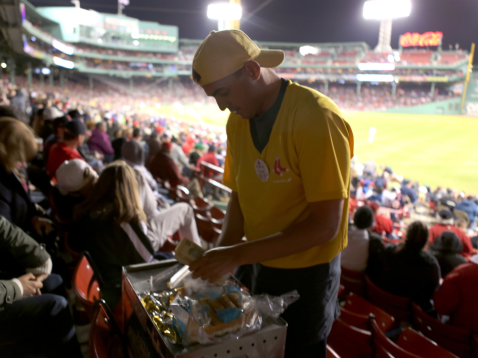 Link: http://www.npr.org/sections/money/2016/05/06/477082513/episode-700-peanuts-and-cracker-jack
Summary: Planet Money attends a Boston Red Sox game at Fenway Park to learn the economics behind the vendors. They discuss why a vendor doesn’t want to sell ice cold water on a cold October night up in the bleachers.
Original Air Date: May 6, 2016
Length: 21 minutes 31 seconds

Link: http://www.npr.org/sections/money/2016/07/27/487654380/episode-714-can-a-game-show-lose
Summary: Planet Money discusses whether a game show can lose and what it takes for a contestant to win. They look into the one-season wonder of the unsustainable model of the game ‘The Power of 10’.
Original Air Date: July 27, 2016
Length: 21 minutes 11 seconds
 audioecon